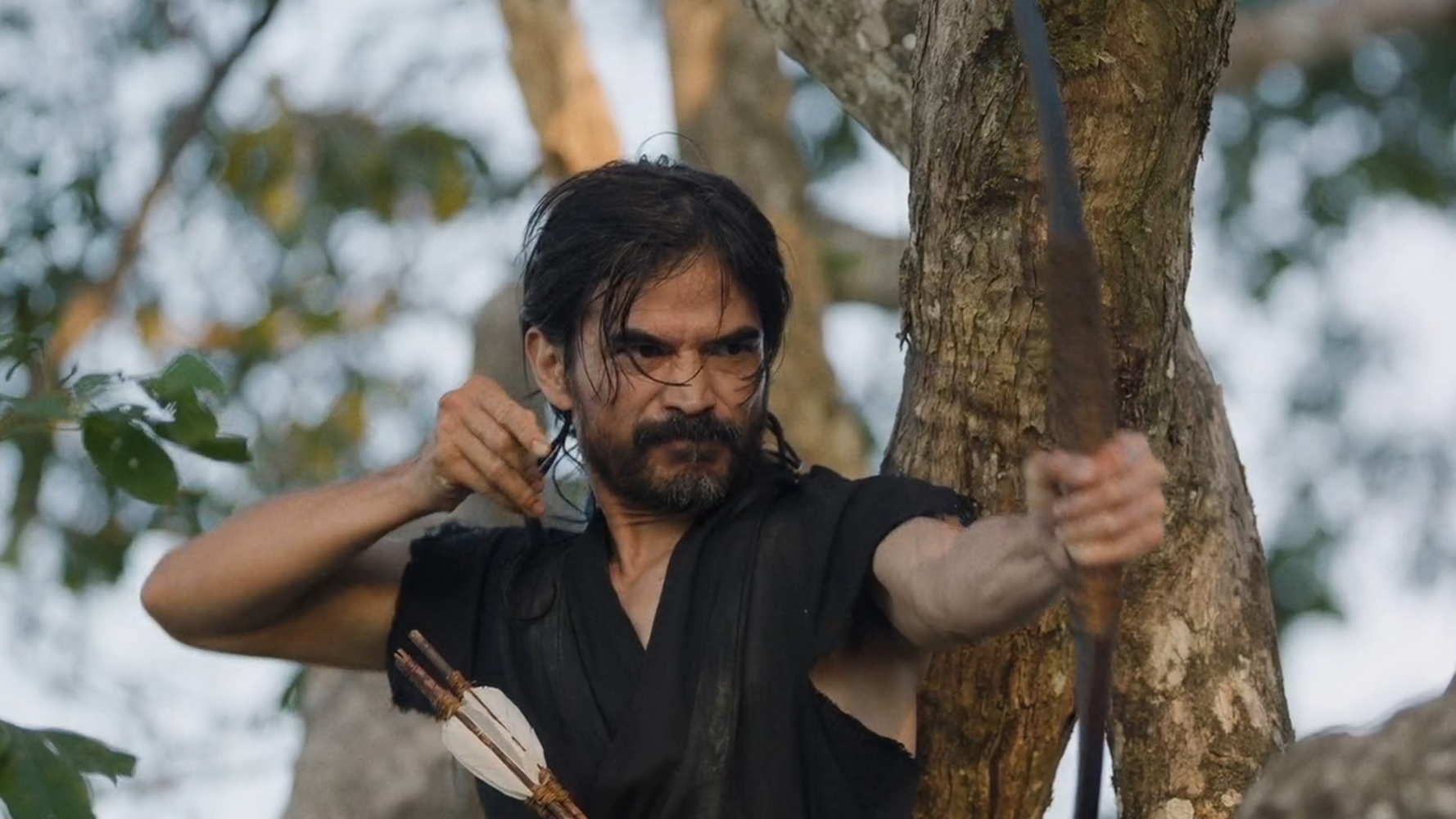
Lone Samurai is a film written and directed by Josh C. Waller, starring the Okinawan born actor Shogen in the lead role of Riku. Taking place in 1281, after Kublai Khan’s second failed attempted invasion of Japan, Riku finds himself shipwrecked after sneaking aboard a Mongolian ship in a mission against the invaders.
Historically this event did actually occur, and the invasion was a failure predominantly due to two typhoons that were later called the Kamikaze winds, which can translate to “divine wind.”
Lone Samurai is a visually stunning film that explores a Samurai’s internal struggle as much as it does Samurai action, perhaps even more so. Riku’s journey on the island plays out primarily through a mental battle, and ultimately culminates with an epic physical one.

Review – A Samurai’s Struggle Through Mental and Physical Extremes
Lone Samurai opens with Riku still on the boat as the second typhoon hits, destroying the ship and leaving him stranded and injured on a secluded island. He traverses empty landscapes, showcasing the loneliness that forces one to look inward and face themselves. For a moment, Riku even believes he saw a person, only to be emotionally ruined at the realization that nobody was there. Much of the film’s themes can be derived simply through the wide landscape shots of the samurai in the center of the frame, walking on the beach, showcasing the beauty of nature, juxtaposed by the injured, solitary figure limping across the landscape.
Eventually, Riku wants to commit Sepukku – ritual suicide. In that moment, there’s a shot that follows Riku’s eye as he gazes upon a mountain. A closeup of his face shows the reflection of the mountain, covered in clouds. That striking image sets the stage for the continuation of his journey and survival. The way Riku struggles is portrayed so beautifully through the cinematography and the direction does so much to visually portray his internal struggle, since the film has very little dialogue.
While the exploration of Riku’s struggles is beautifully shot, the film is vague enough that the backstory leaves more to be desired. In the dialogue, Riku’s past is teased, however it is not fully explored. He has visions that hint that the ghosts of his past may literally be ghosts, but the weight of their presence can’t be fully felt. Are they dead, or is our hero is simply missing the life he left behind? Elaboration on this might have allowed the viewer to sympathize with Riku further. If he has a family to go back to, his journey would have been more compelling, while if they’re already dead, it would make his journey feel even more tragic.
While the emotional weight of the film’s first half doesn’t land as hard as it could, the second half more than delivers on the action sequences. Lone Samurai in a sense has two phases, centered around his captivity. First, is the shipwreck and Riku’s struggle with mental fortitude, and second, Riku is captured by cannibals who live on the island he’s stranded on, leading to some stellar fight scenes. Without delving into spoilers, the fight choreography alone makes this film worth watching.

However, Riku’s time in captivity by the cannibals is a very dark and gory midsection of the film that feels inconsistent with the rest. While Riku’s hinted at history is thematically dark, it’s not as visually dark as his captivity. In one scene, Riku watches the leader of the cannibals cut off another captive’s tongue, among other things. The cave scenes earlier in the film contain some of the film’s most evocative visuals, which make the violence feel gratuitous by contrast. That being said, the costumes are very intimidating, which adds to the unsettled feeling of the cannibals.
When we finally do get to the fight scenes, they are well worth the wait. In addition to the clever choreography, Shogen’s physicality and delivery of every strike is beautiful to watch. His performance not only in the mental fight, but the physical, is very engaging. Through the emotional journey Shogen takes you on with his performance, you can almost feel the serenity he exudes, as prepares to face off against a cannibalistic horde. Even within the fights in the end, there are a few different individual fights that all make for a riveting final act.
In large part the fight scenes in Lone Samurai, choreographed by Iko Uwais (The Raid), stand out by the way the crowd fights are handled. It’s often easy to think during a film how convenient it is that a lead character can fight off so many attackers at once, but the action in this film does a good job of making that feel like a great task. The film’s connection to The Raid also include Yayan Ruhian, who has a great fight scene with Shogen.
The fight scenes, like the rest of the film, feature beautiful cinematography and direction. Just before the final battle begins, a shot focused on Riku’s blade showcases the massive cannibal horde, making one wonder how he can possibly make it out of this battle alive. Lone Samurai explores a samurai’s journey in all its parts, through introspection, captivity, and action.
Rating – 3/5 Pocky


Jorgie is a Senior Writer at POC Culture and a passionate pop culture fan. Jorgie loves learning about visual effects, production, film, and art, and how they all come together to make epic films like Star Wars.