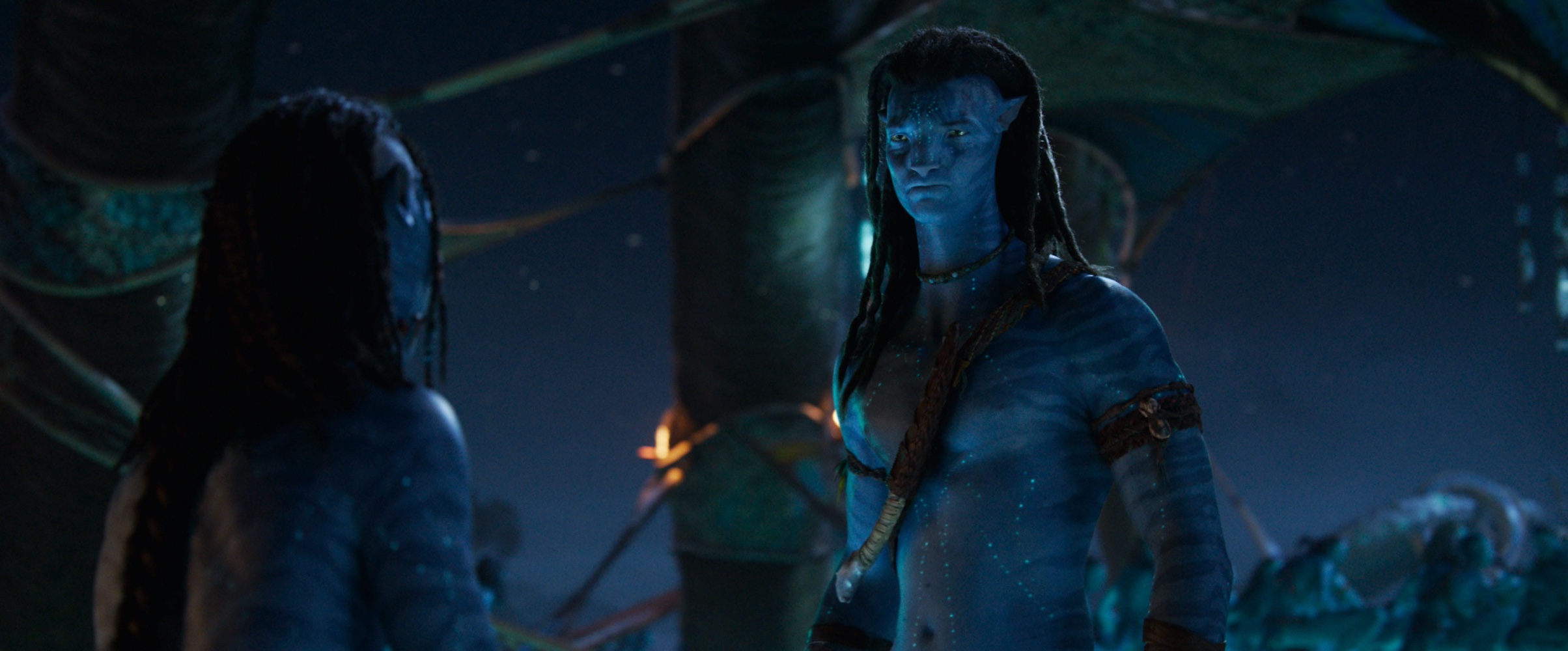
James Cameron’s Avatar is back with Fire and Ash, the third film in the global blockbuster franchise. While audiences needed to wait 13 years between the first Avatar film and the sequel, this third entry into the franchise was filmed together with The Way of Water, allowing for a much quicker turn around. Nevertheless, due to all of the substantial post-production needs that go into an Avatar film, as well as various other industry issues, Fire and Ash still needed 3 more years since the release of its predecessor.
Those 3 years were utilized well, as Avatar: Fire and Ash is yet another visual triumph. Cameron continues to push film visuals to new levels, and fans who love this franchise for its technological achievements will not be disappointed.
Like the other two Avatar films, the plot and character development are Fire and Ash’s weak points; both feel like after thoughts, an ongoing issue with the tech focused franchise. However, with three films and almost 10 hours of story in this world, the sheer time spent with these characters helps to somewhat alleviate the storytelling weaknesses that have plagued these films.
Avatar: Fire and Ash releases December 19, 2025 and it quite obviously must be watched on the biggest and best screen possible.

Official Synopsis:
With “Avatar: Fire and Ash,” James Cameron takes audiences back to Pandora in an immersive new adventure with Marine turned Na’vi leader Jake Sully (Sam Worthington), Na’vi warrior Neytiri (Zoe Saldaña), and the Sully family. “Avatar: Fire and Ash,” which is directed by James Cameron and features a screenplay by James Cameron & Rick Jaffa & Amanda Silver, and a story by James Cameron & Rick Jaffa & Amanda Silver & Josh Friedman & Shane Salerno, is produced by James Cameron, p.g.a., and Jon Landau, p.g.a., with Richard Baneham, Rae Sanchini, and David Valdes serving as executive producers. The film also stars Sigourney Weaver, Stephen Lang, Oona Chaplin, Cliff Curtis, Joel David Moore, CCH Pounder, Edie Falco, David Thewlis, Jemaine Clement, Giovanni Ribisi, Britain Dalton, Jamie Flatters, Trinity Jo-Li Bliss, Jack Champion, Brendan Cowell, Bailey Bass, Filip Geljo, Duane Evans, Jr., and Kate Winslet.
Review – Avatar: Fire and Ash Takes Visuals to New Heights but Issues Persist
James Cameron’s Avatar films are true epics. They require epically massive teams to film in 3D and craft the jaw dropping visual effects, and they tell epically long stories that span the fictional alien world of Pandora. From a technical perspective, the Avatar franchise is unimpeachable, and Fire and Ash is no exception. At a time when other franchises like Marvel, Jurassic World and Star Wars routinely churn out impressive visual feasts, Avatar somehow continues to set itself apart.
By now, the Avatar franchise’s third film, audiences should know what to expect. The things that Fire and Ash does well, it does exceptionally well. Visually, Cameron’s films can’t be matched. The 3D filmmaking, the world building, and the creature and set designs, are all exquisite. Because we’ve spent over 6 hours in the weird world of Pandora already, this film has a level of comfort and familiarity that makes the world feel even more real. In the previous films, the alien fauna and flora made for some moments that felt too artificial. Now, we’re more settled into this world that Cameron has created, and it allows for a more immersive experience.

New Villains Breathe New Life Into the Franchise
I’ve never been a fan of the giant feline character designs of the Na’vi, which are often look awkward and are generally unrelatable. The insertion of the human character Spider (Jack Champion) in The Way of Water added a constant visual contrast that made the Na’vi feel even more alien and distant. However, Fire and Ash introduces a new group from Pandora, the fiery Mangkwan clan led by Varang (Oona Chaplin). The new antagonist’s striking white, red and black design provide a nice contrast to the Na’vi that we didn’t see in the second film. Varang in particular is a deliciously evil antagonist that this franchise has been lacking from non-human characters. Yes, the humans are still evil and Colonel Miles Quaritch (Stephen Lang) continues to play the primary villain to Jake (Sam Worthington), Neytiri (Zoe Saldaña) and the rest of the Na’vi, but the villains in Avatar prior to this film have largely felt like caricatures. Varang and the Mangkwan add an more unique element to the story that give it a bit more depth, because it shows us what conflict within the world of Pandora looks like without human intervention. Of course, as with most conflicts, humans just add fuel to the fire, and having Quaritch team up with Varang, and even have his own loyalty to the human military forces tested, adds a level of intrigue that is necessary and welcome.
The real stand out character designs are the beautifully crafted creatures throughout the film and how the story utilizes them. From stunningly colorful flying creatures of varying shapes and sizes, to massively regal ocean dwellers who turn out to be some of the most wise and revered beings on Pandora, Cameron and his team truly raised the bar in further fleshing out this world. There are several aerial battles between the Na’vi and Mangkwan that are worth the not insignificant price of admission alone.

James Cameron Continues to Redefine Visual Effects
Cameron launched the 3D film revolution back in 2009 with the first Avatar film, creating never-before-seen visual effects and an immersive experience that felt like the start of a new era of filmmaking and theater experiences. In 2025, we now know that it’s not easy to replicate Cameron’s genius with the technology and the broad interest in 3D films has waned. In many ways, Cameron has benefited from the shrinking of the 3D film industry, as he is recognized as the technology’s unparalleled master. For many films, the burden of watching with 3D glasses and the extra cost of admission just isn’t worth it. But for Avatar, it absolutely is. Cameron’s expertly crafted world demands to be experienced in the most immersive way possible. 3D, IMAX, Dolby…it’s all worth it for a film like Fire and Ash.
While Fire and Ash is a visual masterpiece, much like the previous two films in the franchise, the story and character development are its weaknesses. For a substantial portion of the film, there is an undeniable feeling that we’ve been here before. It’s akin to the feeling of wandering around in a forest only to come across your starting point. The character feel the same as we last saw them, the dynamics have barely changed and the main tension remains the same. Once again, Quaritch is hunting Jake, Neytiri and his family. The humans are still intent on pillaging and plundering all of Pandora’s rich resources and present an existential threat to the Na’vi people. And once again, all of this leads to a massive battle that comes down to Quaritch and Jake dueling it out, with Spider in the middle. Despite over 6 hours of runtime in the previous two films, it’s not long into this one before you realize that very little has been resolved. Given the static story and character dynamics, Avatar begins to feel more like an incredible theme park ride that we’re experiencing for a third time.

Story and Character Development Remain the Franchise’s Weakness
Throughout, the film is rife with awkward, goofy and unintentionally funny moments thanks to clunky dialogue and characters that you just don’t care about. Spider continues to be one of the most annoying and uncomfortable characters in the series. It’s still not clear if the intent of his character is to provide viewers with a relatable human protagonist, but the execution is lacking. Spider feels like the person who just loves co-opting other cultures, and what we see from Spider in this film only serves to reinforce that sentiment.
Adding to the frustrating lack of character development is the continued underutilization of Zoe Saldaña’s Neytiri, who remains little more than a character that exists to serve Jake’s journey. From saying she would never speak out publicly against her husband to spending most of the film doing nothing but mourning in the background, Neytiri lacks depth. She does have a great action sequence towards the end of the film, but by then it feels too little, too late. Not only is Neytiri far outshined in the story by Jake, but she takes a back seat to Spider, Quaritch and even Varang.
Ultimately, the central discomfort of the Avatar franchise is due to the primary species of characters and the human interactions with those characters. Who the Na’vi are meant to represent has always been clear. With their manner of speech, their style of clothing and rudimentary weapons, they are an outsider’s view of Indigenous and Pacific Islander communities. And yet there remains a noticeable lack of Indigenous or PI actors in the main cast. This oversight could have been somewhat excused in 2009, before cultural awareness became more of an emphasis in Hollywood. But in 2025, with 3 films under the franchise’s belt, it’s a glaring issue.
Avatar: Fire and Ash takes the franchise to new heights from a technical perspective, but fails to bring the story and characters along with it; and in the end, that’s a disappointment.
Rating – 2.5/5 Pocky


Ron is the founder and Editor-in-Chief of POC Culture. He is a big believer in the power and impact of pop culture and the importance of representation in media.